 Traveling Knife Gal
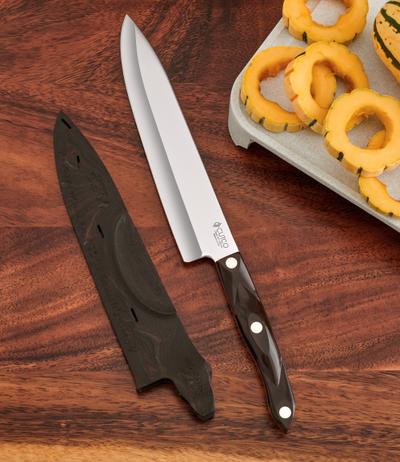
The kitchen's all-around workhorse
Cutco 9-1/4" French Chef #1725
If you could only own one big knife, this is it. The curved straight-edge blade rocks through onions, herbs and peppers, and the wide blade doubles as a scoop to carry everything to the pan.
- Blade
- 9-1/4 inches
- Edge
- Straight edge, 15° per side
- Steel
- 440A high-carbon stainless
- Build
- Full tang, 3 nickel-silver rivets
- Handle
- Thermo-resin, Classic or Pearl
- Guarantee
- Forever Guarantee with free sharpening
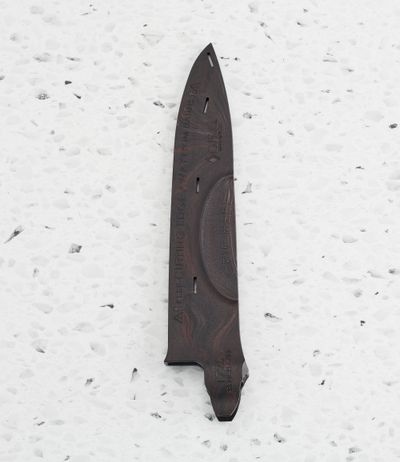
The Cutco 9-1/4" French Chef (#1725) is the all-around workhorse: a straight-edge blade for chopping, slicing, dicing and mincing produce, with a gently curved edge for a rocking chop and a wide blade for scooping food off the board. Hold it with a pinch grip, keep your other hand in a claw, and let it rock. Hand wash and dry it, store it in a block or sheath, and send it to Cutco for free sharpening when it stops slicing cleanly.
What it’s best for
A chef's knife is the one you'll reach for most, and Cutco's French Chef is built for exactly that everyday, do-everything prep. Cutco lists it for chopping, slicing, dicing and mincing produce, and that's where it shines:
- Onions, shallots and peppers: dicing for sauces, salsas and stir-fries.
- Herbs and garlic: a fast rocking mince with the curved front of the blade.
- Big produce: halving melons, cabbage and squash, and slicing root vegetables like carrots and potatoes.
- Boneless meat and chicken: cutting chicken breasts into strips or cubes, slicing flank steak for fajitas.
- Scoop and carry: the wide blade lifts a pile of chopped food straight to the pan.
What not to use it for
A thin, sharp edge is precise, not indestructible. Reach for a different tool for these jobs:
- Bones and frozen food: use a cleaver. Prying or chopping through bone can chip or bend any chef's knife.
- Crusty bread and tomatoes with tough skin: Cutco's Double-D slicers grip crusts and skins better.
- Peeling and small in-hand work: a paring knife or trimmer is safer and easier to control.
- Carving a roast or turkey: a long, narrow carving knife makes cleaner slices.
How to hold it
Use the pinch grip: wrap your middle, ring and little fingers around the handle, then pinch the blade just in front of the handle between your thumb and the side of your bent index finger. It feels odd for a day and then you'll never go back. It gives you far more control than holding the handle like a hammer.
Your other hand is the guide. Curl the fingertips under into a claw and rest your knuckles against the side of the blade. The knife can only go where your knuckles let it, and your fingertips stay out of the way.
The three cuts to know
- The rock chop. Keep the tip on the board and rock the curved blade up and down, feeding food under it with your claw hand. This is the go-to for herbs, garlic and a fast rough chop. The French Chef's subtly curved blade is shaped for exactly this motion.
- The push cut. Lift the whole knife and slide it forward and down through the food in one motion, heel to tip. This gives the cleanest dice on onions, peppers and celery, and it's the easiest cut on firm vegetables like carrots.
- The slice (pull cut). Start near the heel and draw the knife back toward you in one long stroke. Use it for boneless chicken breasts, steak and anything soft that you don't want to crush.
Let the knife do the work. If you're pressing hard, the edge needs attention. A sharp French Chef falls through an onion with almost no pressure.
French Chef vs Petite Chef vs Santoku
All three are Cutco's main prep knives with straight edges. The difference is size and shape:
| 9-1/4" French Chef | 7-5/8" Petite Chef | 7" Santoku | |
|---|---|---|---|
| Shape | Long, curved blade with a pointed tip | Same shape, shorter | Flatter blade with a low, rounded tip |
| Best motion | Rocking chop and long slices | Rocking chop in tighter spaces | Straight up-and-down chopping and thin slicing |
| Choose it if | You cook a lot, prep big batches or have large hands | You want a chef's knife that feels lighter and more nimble | You prefer chopping straight down; Cutco also likes it for sushi and butterflying chicken |
Plenty of cooks own both a chef's knife and a santoku. Faith can put one in your hand at an event so you can feel the difference, or help you pick one in Build Your Block.
Care and storage
- Hand wash and dry it right away. The thermo-resin handle is dishwasher safe, but knocking around in a dishwasher is the fastest way to dull any edge.
- Cut on wood or plastic. Glass, stone and ceramic dull a blade quickly.
- Store it in a block, tray or sheath so the edge isn't banging against other tools in a drawer.
- Keep it away from the garbage disposal and a hot burner. Damage like that isn't normal wear; Cutco replaces it for half price under the Forever Guarantee.
- Spots? 440A is stainless and resists rust, but if acidic food or water spots sit on it, clean them with a mild non-abrasive cleaner and dry it.
Keeping it sharp
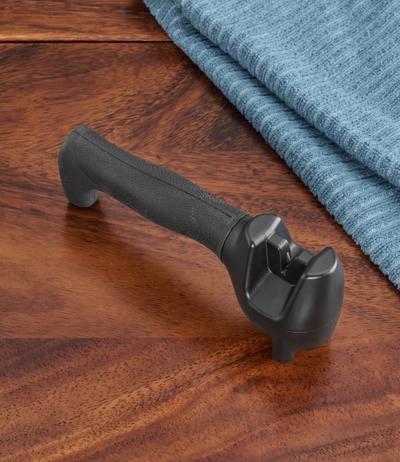
The French Chef has a straight edge ground to Cutco's standard 15 degrees per side, which means you can touch it up yourself with the Cutco Knife Sharpener between professional sharpenings. A few light passes when it starts to slide off a tomato skin is all it needs.
When it needs more than a touch-up, it's free. Cutco's Forever Guarantee includes free sharpening for life (a small return shipping fee applies by mail), and Faith sharpens Cutco at her service events. Request sharpening here.
Questions
What is the Cutco French Chef knife used for?
Chopping, slicing, dicing and mincing produce, plus boneless meat and chicken. The curved blade rocks for mincing herbs and garlic, and the wide blade scoops food off the board.
Is the Cutco French Chef straight edge or Double-D?
Straight edge. Cutco grinds it to 15 degrees per side, so you can touch it up at home with the Cutco Knife Sharpener, and Cutco sharpens it free under the Forever Guarantee.
How long is the Cutco French Chef blade?
The French Chef is Cutco's 9-1/4 inch chef's knife (#1725). The 7-5/8 inch Petite Chef (#1728) is the smaller version.
Should I get the French Chef or the Santoku?
Choose the French Chef if you like a rocking chop and longer slices; choose the 7" Santoku if you chop straight up and down and want thinner slices. Many cooks own both.
Can the Cutco French Chef go in the dishwasher?
The handle is dishwasher safe, but hand washing and drying right away keeps the edge sharp much longer.
How do I get my Cutco French Chef sharpened?
Bring it to one of Faith's service events or request sharpening through her, or mail it to Cutco. Sharpening is free under the Forever Guarantee; a small return shipping fee applies by mail.
Keep reading
Sources: Cutco: 9-1/4" French Chef · Cutco: Types of Knives · Cutco: Just the Facts · Cutco: The Forever Guarantee