 Traveling Knife Gal
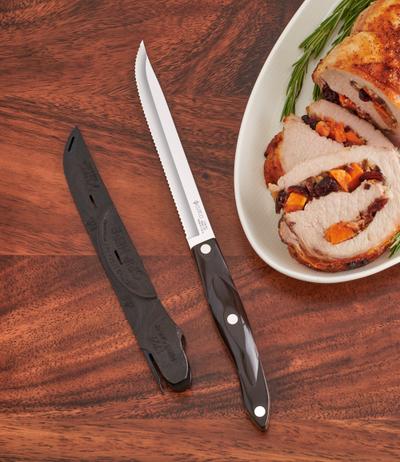
The knife you want for slicing steak
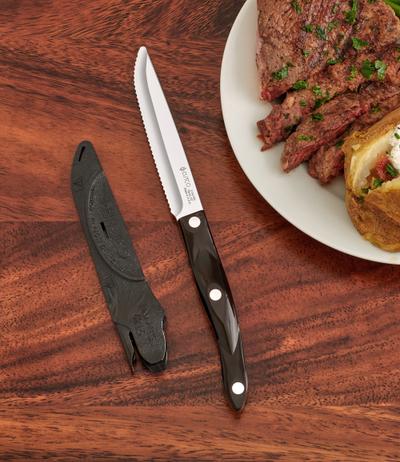
Cutco 6-3/4" Petite Carver #1729
Cutco made the Petite Carver for smaller cuts of meat; its 6-3/4" Double-D® blade slices a flank steak or tri-tip thin and clean without shredding the crust.
- Blade
- 6-3/4 inches
- Edge
- Double-D®, three recessed cutting edges
- Steel
- 440A high-carbon stainless
- Build
- Full tang, 3 nickel-silver rivets
- Made in
- Olean, New York
- Guarantee
- Forever Guarantee with free sharpening
Rest the steak 5 to 10 minutes. Find the grain, the parallel lines of muscle fiber, then turn the steak so your knife crosses those lines at a right angle. Slice thin, about 1/4 inch, on a slight angle for wide, tender pieces. This matters most on flank, skirt, hanger and tri-tip.
What "the grain" is
Muscle is made of long fibers bundled in one direction. Slice along them and every bite is a long, chewy rope. Slice across them and you cut those fibers short, so the meat is tender in your mouth.
How to find it
Look for the parallel lines on the surface. They're obvious on flank, skirt and hanger steak. Tri-tip and brisket change direction partway through, so check as you go and turn the meat.
Slicing, step by step
- Rest the steak 5 to 10 minutes so juices settle.
- Turn it so the grain runs left to right in front of you.
- Slice across the grain about 1/4 inch thick, tilting the knife 30 to 45 degrees for wider slices.
- Use long, single strokes; don't saw.
Questions
What does slicing against the grain mean?
Cutting across the direction the muscle fibers run, so each slice has short fibers and is tender.
Which steaks need to be sliced against the grain?
Most of all flank, skirt, hanger and tri-tip, plus brisket and London broil.
What knife is best for slicing steak?
A sharp carving or slicing knife, such as Cutco's 6-3/4" Petite Carver for smaller cuts.
Keep reading
Sources: Cutco: 6-3/4" Petite Carver