 Traveling Knife Gal
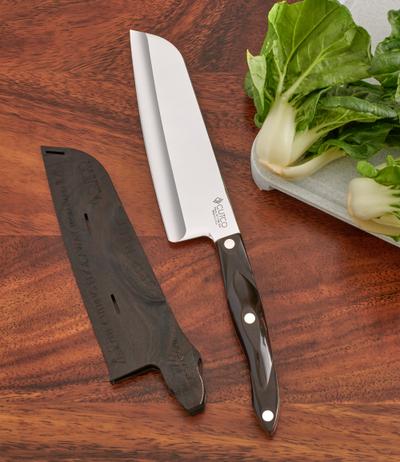
For straight-down chopping and paper-thin slices
Cutco 7" Santoku #1766
A flatter, straight-edge blade with a low tip that puts the whole edge on the board, perfect for fast push-chopping, thin cucumber and onion slices, and butterflying chicken.
- Blade
- 7 inches
- Edge
- Straight edge, 15° per side
- Steel
- 440A high-carbon stainless
- Build
- Full tang, 3 nickel-silver rivets
- Made in
- Olean, New York
- Guarantee
- Forever Guarantee with free sharpening
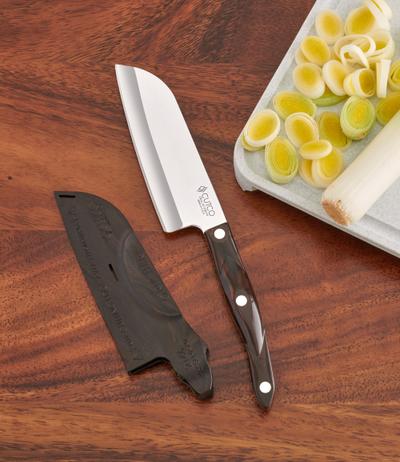
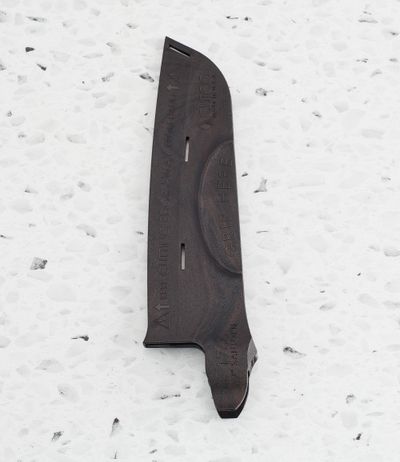
A santoku has a flatter edge and a low, rounded tip, so it chops best with a straight up-and-down or forward push rather than a rock. Cutco's 7" Santoku (#1766) and 5" Petite Santoku (#2166) have straight edges for chopping, slicing and dicing produce, and Cutco notes the low tip is ideal for intricate cutting, slicing sushi and butterflying chicken breasts.
What makes a santoku different
The santoku is a Japanese-style all-purpose knife. Compared with a Western chef's knife, its edge is flatter and the spine drops down to a low, rounded tip. That flat profile keeps more of the edge on the board at once, which suits a push cut or a straight up-and-down chop instead of the rocking motion a curved chef's knife is built for.
What Cutco's Santoku is for
Cutco lists both Santokus for chopping, slicing and dicing produce, and calls out the low tip as ideal for intricate cutting and boning, slicing sushi and butterflying chicken breasts. Their straight edges give clean, smooth cuts on soft and firm food alike:
- Thin slices of cucumber, onion, zucchini and potatoes for gratins.
- Fast dicing of carrots, celery and peppers with a forward push.
- Butterflying chicken breasts and slicing raw fish for sushi.
- Scooping chopped food off the board with the wide blade.
Santoku vs chef's knife
Neither is "better"; they suit different motions. If you rock your knife, you'll love a chef's knife like the French Chef. If you chop straight down or slide the knife forward, a santoku will feel natural. Many cooks keep one of each.
7" or 5" Petite?
The 7" Santoku is a true main prep knife. The 5" Petite Santoku is a nimble second knife for small jobs, a single onion, an apple, a chicken breast, and great for cooks who prefer a compact blade.
Care and sharpening
- Hand wash with warm soapy water and dry it right away. The handle is dishwasher safe, but the dishwasher is hard on any edge.
- Cut on wood or plastic, never glass, stone or a plate.
- Store it in a block, tray or sheath, not loose in a drawer.
This is a straight edge, ground to Cutco's 15 degrees per side, so a few light passes on the Cutco Knife Sharpener keep it keen between professional sharpenings. When it needs a real sharpening, Cutco does it free under the Forever Guarantee: bring it to Faith's service events or request sharpening. See how to sharpen kitchen knives.
Questions
What is a santoku knife used for?
Chopping, slicing and dicing produce, plus thin slicing of meat and fish. Its flat edge and low tip suit straight-down chopping and push cuts.
Is the Cutco Santoku straight edge?
Yes. Both the 7" Santoku and 5" Petite Santoku have straight edges.
Is a santoku better than a chef's knife?
Not better, different. A santoku suits straight-down chopping and thin slicing; a chef's knife suits a rocking chop. Choose by the way you cut.
What are the dimples on some santokus for?
Some santokus have hollow-ground dimples to reduce sticking. Cutco blades are hollow ground on both sides to reduce drag, which helps food release.
Keep reading
Sources: Cutco: item 1766 · Cutco: item 2166 · Cutco: Types of Knives · Cutco: How Cutco Knives Are Made